
[[{“value”:”
Scripture reading – James 3
* Please note that words and phrases in brackets are the author’s amplification.
James 3
Our study of the Epistle of James continues with chapter 3. The epistle addresses three significant themes: Trials, Temptations, and the Tongue. Chapter 3 is both practical and convicting. It focuses on the tongue and its trouble for all humanity, then contrasts earthly and heavenly wisdom.
A Warning To Teachers (James 3:1)
“My brethren, be not many masters [i.e., teachers], knowing that we shall receive the greater condemnation” (James 3:1). The word “master” essentially means teacher (an experienced professor may be called a “master teacher”). James included himself in the warning, writing, “We [teachers] shall receive the greater condemnation” (James 3:1b). Because the tongue is the tool of all who teach, James warned that those who teach will face God’s stricter judgment.
The Tongue: Its Characteristics and Dangers (James 3:2-12)
James identified the tongue as an instrument of both good and evil. The tongue has the power to bless or curse, to affirm or offend, and to cause some to err. The tongue is so powerful and influential that only a “perfect man” (one mature and spiritually disciplined) can restrain and bridle it (James 3:2).

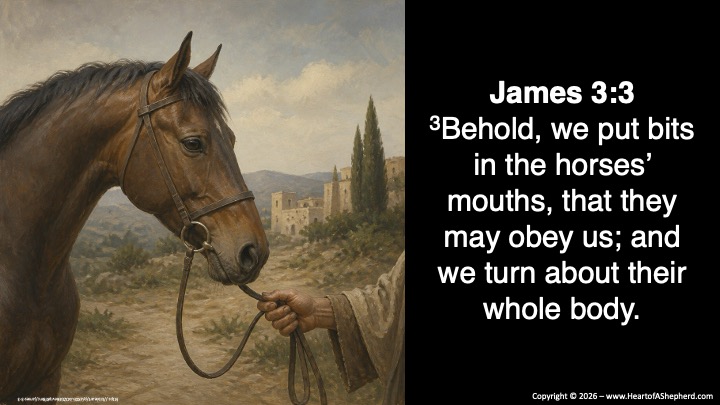
Though small, the tongue boasts much and has great power and influence. Consider two analogies James used to illustrate the tongue’s impact. The first compares the tongue to the tiny bit in a horse’s mouth. Though small, the bit harnesses the horse’s strength and brings the horse’s will under the rider’s authority (James 3:3). The same is true of a ship’s rudder, which the KJV calls a “very small helm” (James 3:4). Though small in proportion to the ship, the rudder can guide a massive vessel through “fierce winds” and troubled seas.
The application: As the bit is to a horse and the rudder is to a ship, so is the tongue to the individual. Though small, the tongue can boast and destroy lives, marriages, families, and institutions (James 3:5). “The tongue is a fire, a world of iniquity [evil]: so is the tongue among our members, that it defileth [stains; pollutes] the whole body, and setteth on fire the course of nature; and it is set on fire of hell” (James 3:6). Just as a spark can ignite a raging forest fire, so the tongue, unchecked, can destroy everyone and everything.
Man’s tongue is also restless and untamed (James 3:7-8). Men have tamed “every kind of beasts, and of birds, and of serpents, and of things in the sea,” but no man has ever tamed the tongue (James 3:7-8a). Why? Because the tongue is by nature “an unruly evil, full of deadly poison” (James 3:8b). Treacherous and hypocritical, we bless God with the same tongue we use to curse men, who are made “after the similitude of God” (James 3:9). James then declared, “My brethren, these things ought not so to be” (James 3:10).

Three Things that Cannot Be (James 3:10-12)
To illustrate how intolerable it is for a tongue to worship God while cursing men, James offered three examples from nature. First, a fountain cannot send forth both sweet and bitter water from the same opening (James 3:11). Second, a fig tree cannot bear olive berries, nor can a vine bear figs (James 3:12a). Finally, no fountain can “yield salt water and fresh” (James 3:12b).
A Contrast Between Earthly and Heavenly Wisdom (James 3:13-16)
James 3 begins with a warning to teachers (James 3:1), and I suppose the “wise man” in the passage is the teacher. Teachers with heavenly wisdom will exemplify three qualities. Their conversation [not just their words, but their ways] will uphold the highest moral good; their works will be evident to all; and both will display “meekness of wisdom” (James 3:13b).
In contrast, worldly wisdom is the antithesis of heavenly wisdom. The world’s wisdom harbors “bitter envying and strife” in the heart (James 3:14a). Man’s wisdom is selfish, ambitious, proud, and deceitful (James 3:14b). Such wisdom is born in the hearts of sinful men and “descendeth not from above, but is earthly, sensual, devilish” (James 3:15). The Spirit of God will not tolerate envy and strife.
Warning: Where envying and strife are tolerated, “there is confusion and every evil work” (James 3:16).

Closing thoughts (James 3:17-18)
True wisdom comes from God, and its character reflects His nature. True wisdom is “first pure” (morally pure), peaceable (pursuing peace with others), gentle (kind and patient), reasonable (“easy to be intreated”), merciful (“full of mercy,” compassionate and caring), bears “good fruits” (caring, loving actions), is impartial and just (“without partiality”), and is honest and sincere (“without hypocrisy”) (James 3:17).
What is the effect of godly wisdom? “The fruit of righteousness [obeying God’s law and commandments] is sown in peace of them that make peace” (James 3:18). The wise sow peace and reap a harvest of righteousness, leading to peace with God and others.
Are you wise or foolish? Which wisdom characterizes your heart and life?
Study Questions for James 3
- James compares the tongue to a horse’s bit, a ship’s helm, and a small fire. Which comparison speaks most to you, and why? (James 3:3-6)
- James says, “These things ought not so to be,” and he points to a fountain, a fig tree, and a vine. What does the tongue reveal about the heart? (James 3:9-12). What does it look like in practice to “bless God,” yet still speak carelessly of people made “after the similitude of God”? (Compare Matthew 12:34, “out of the abundance of the heart the mouth speaketh.”)
- James lists eight marks of the “wisdom that is from above” in verse 17. Which one is most evident in your life, and which one is most lacking? Read verses 14-16 again. Where might “bitter envying and strife” be showing up in your home, church, or workplace? What would it look like this week to be one of “them that make peace” (James 3:18)?
Copyright © 2026 – Travis D. Smith
* Please subscribe to the Heart of a Shepherd daily devotionals by entering your name and email address at the bottom of today’s devotion.
The Internal Revenue Service recognizes Heart of A Shepherd Inc as a 501c3 public charitable organization. Your donation is welcome and supports the worldwide ministry outreach of www.HeartofAShepherd.com.
Heart of A Shepherd Inc.
7853 Gunn Highway
#131
Tampa, Florida 33626-1611
Heart of a Shepherd
A ministry of Pastor Travis D. Smith
Support Heart of a Shepherd
This ministry is made possible by the generous donations of our readers.
The post Bite Your Tongue: The Tongue and Its Nature (James 3) appeared first on “From The Heart of A Shepherd” by Pastor Travis D. Smith.
“}]]