
[[{“value”:”
Scripture reading – James 1; James 2
* Please note that words and phrases in brackets are the author’s amplification.
Our two-year chronological study of the Scriptures continues with a brief departure from the Acts of the Apostles as we turn to the book of James. At the close of Acts 14, we found Paul and Barnabas returning to Antioch in Syria after their first missionary journey through the towns and cities of Asia Minor (now known as Turkey).
Paul and Barnabas reported that God “had opened the door of faith unto the Gentiles” (Acts 14:27). Both Jews and Gentiles professed faith in Christ, were baptized, and were added to the church. That diversity—Jew and Gentile (many of the latter from Greek and Roman backgrounds)—soon exposed tensions between circumcised Jews and uncircumcised Gentiles. (That will be our topic of study in Acts 15, when Paul and Barnabas journey to Jerusalem to give an account of their ministry among the Gentiles.)
Why interrupt our study of Acts to focus on the Epistle of James? The answer lies in the letter’s date and authorship. Many conservative scholars believe James was written around AD 45–49, making it perhaps the earliest book of the New Testament and written before the Jerusalem council in Acts 15. Its author is also about to take center stage in the Book of Acts.

Introduction (James 1:1)
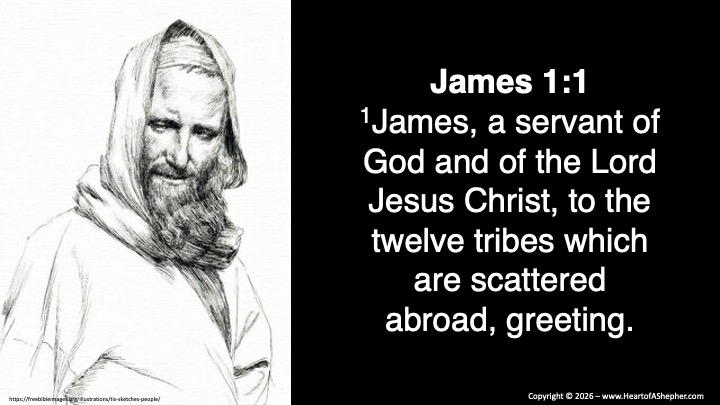
The Epistle of James is a letter bearing the name of its author. The writer introduced himself and his recipients in the opening verse: “James, a servant of God and of the Lord Jesus Christ, to the twelve tribes [the Tribes of Israel] which are scattered abroad [dispersed], greeting [rejoice; be glad]” (James 1:1).
With humility, James identified himself as “a servant,” a slave “of God and of the Lord Jesus Christ” (James 1:1). Several men named James appear in the New Testament; however, this James felt no need to identify himself further, perhaps because he needed no introduction. By the time this epistle was written, the apostle James, the brother of John and son of Zebedee, had already been martyred (Acts 12:2), ruling him out as the author. Most scholars identify the writer as James, Jesus’ half-brother (Matthew 13:55; Galatians 1:19), the son of Joseph and Mary. We know that James and his brothers did not believe in Jesus during His earthly ministry (John 7:5). After His resurrection, however, the Lord appeared to James (1 Corinthians 15:7), and Acts 1:14 names Jesus’ “brethren” among those who gathered in “an upper room” after He ascended to heaven.
This same James was recognized as a “pillar” of the church in Jerusalem (Galatians 2:9). In a future devotional, when Paul and Barnabas give their account to the believers in Jerusalem, it will be this James who addresses the assembly of apostles and elders (Acts 15:13). James is again named among the church leaders in Acts 21:18.
This letter is addressed “to the twelve tribes which are scattered abroad” (James 1:1). These were Jewish believers living outside the land of Israel: some were descendants of the captivity who never returned, and others had recently been scattered by persecution (Acts 8:1; 11:19). You will find the Epistle of James practical, insightful, and convicting.

A Righteous Attitude Toward Trials and Temptations (James 1:2-4)
James opened his letter with a bold appeal to believers: “My brethren, count [regard; judge] it all joy [a cause for rejoicing] when ye fall [stand in the midst of] into divers [various] temptations [trials]; 3 Knowing this, that the trying [testing] of your faith [what you believe] worketh [performs; works out; produces] patience [steadfastness; endurance]. 4 But let patience [steadfastness; endurance] have her perfect [maturing; complete] work, that ye may be perfect [mature] and entire [complete], wanting nothing [i.e., lacking not one thing]” (James 1:2–4).
The Means to Overcome Trials and Temptations (James 1:5-12)
What should you do when you face hardship and persecution? Ask God for wisdom (James 1:5), trust Him without wavering (never give in to doubts and fears, James 1:6), and rejoice (James 1:9). Whether you are brought low by poverty or tempted to exalt yourself and depend on riches, remember that wealth is temporary, like grass that withers and flowers that fade (James 1:10–11). Remember, too, that the one who endures trials will be blessed and “shall receive the crown of life, which the Lord hath promised to them that love him” (James 1:12).
The Origin of Trials and Temptations (James 1:13-18)
Among the great truths we might draw from trials and troubles, foremost is the assurance that God will never tempt you to sin (James 1:13). When you are tempted to sin, remember that temptation arises from within the heart: “Every man is tempted, when he is drawn away of his own lust, and enticed” (James 1:14). Some might whine, “The devil tempted me!” Yet while the devil may entice, the appeal to sin takes root in the lust sown in the sinner’s own heart, and it carries a death sentence: “Then when lust hath conceived, it bringeth forth sin: and sin, when it is finished, bringeth forth death” (James 1:15).
The wages of lust and sin are death (Romans 5:12; 6:23). Sin delivers a death blow to marriages, families, careers, hopes, and health, culminating in physical, spiritual, and eternal death. Remember: God is the source of only good, for “every good gift and every perfect gift is from above, and cometh down from the Father of lights” (James 1:17; see also 1:16–18).

Closing Thoughts (James 1:19-27)
How might believers prepare for trials and temptations? The closing verses of James 1 present three key principles.
1) Be Swift to Hear and Slow to Speak (James 1:19–21). In other words, listen attentively to God’s Word (James 1:19), restrain your anger (James 1:20), renounce any sin that separates you from the Lord, and receive “with meekness the engrafted word” (James 1:21).
2) Be a Doer of the Word, Not a Hearer Only (James 1:22–25). Hearing God’s Word without obeying it leads to self-deception (James 1:22). The Word of God is a perfect, flawless spiritual mirror of a man’s soul, and the man who remembers what it reveals and obeys its truths “shall be blessed in his deed” (James 1:25).
3) Bridle Your Tongue (James 1:26). Some appear pious and spiritually devout; however, if they do not bridle their tongues, they deceive themselves, and their religion is vain and empty.
Our devotional study of James 2 must wait until next year. I conclude our study of James 1 by highlighting the qualities of a sincere heart. A sincere heart is selfless and compassionate (visiting “the fatherless and widows in their affliction”) and keeps itself “unspotted from the world” (James 1:27).
How’s your heart?
Copyright © 2026 – Travis D. Smith
* Please subscribe to the Heart of a Shepherd daily devotionals by entering your name and email address at the bottom of today’s devotion.
The Internal Revenue Service recognizes Heart of A Shepherd Inc as a 501c3 public charitable organization. Your donation is welcome and supports the worldwide ministry outreach of www.HeartofAShepherd.com.
Heart of A Shepherd Inc.
7853 Gunn Highway
#131
Tampa, Florida 33626-1611
Heart of a Shepherd
A ministry of Pastor Travis D. Smith
Support Heart of a Shepherd
This ministry is made possible by the generous donations of our readers.
The post Persevering in Trials and Overcoming Temptations (James 1-2) appeared first on “From The Heart of A Shepherd” by Pastor Travis D. Smith.
“}]]