
[[{“value”:”
Scripture reading – Ezekiel 18; Ezekiel 19
* Please note that words and phrases in brackets are the author’s amplification.
This is the second of two Bible studies today. As we continue our chronological journey through the Scriptures, please share and invite others to subscribe to www.HeartofAShepherd.com.
Ezekiel 18 addressed the assertion by some that the LORD was unjust, for they supposed their sorrows and travails were brought upon them because of their father’s sins (Ezekiel 18). Ezekiel refuted their erroneous claims, declaring a sinner’s responsibility for his sins (Ezekiel 18:4) and that “everyone” would be judged “according to his [own] ways” (Ezekiel 18:29).
Ezekiel 19 exhibits the hallmarks of an elegy—a lament and funeral song for Israel and Judah, both as nations and as peoples.
Ezekiel 19
Ezekiel 19 shifts its focus to the influence of wicked rulers on Israel, particularly Judah. Ezekiel commanded the people in captivity in Babylon to “take … up a lamentation for the princes of Israel” (Ezekiel 19:1). Who were the princes? They were the last kings of the Davidic dynasty (of course, David’s lineage will be restored to the throne when Christ reigns in the Millennial Kingdom). Three wicked kings are described in our text. They were: Jehoahaz (Ezekiel 19:3-4), Jehoiachin (Ezekiel 19:5-9), and Zedekiah, the last king of Judah (Ezekiel 19:14).
The Lioness and Her Cubs (Ezekiel 19:1-9)
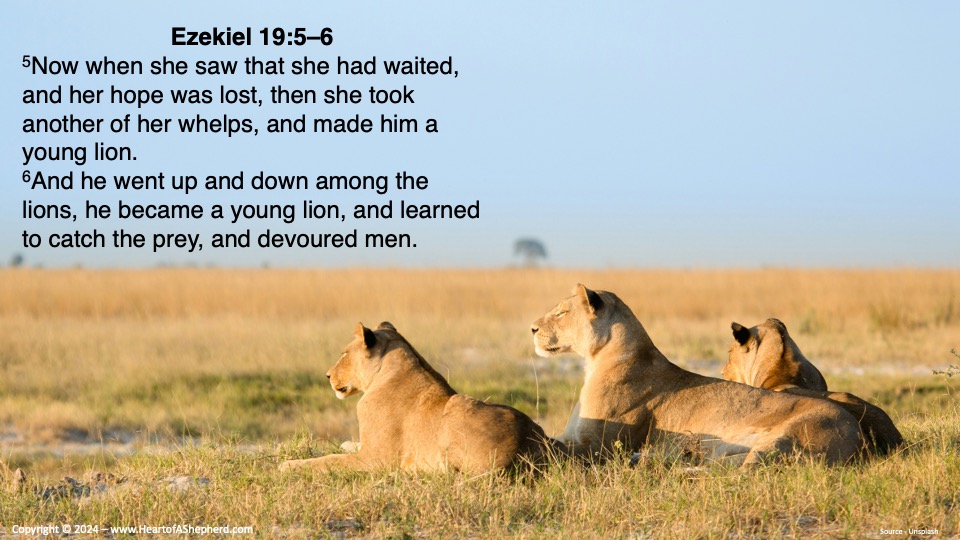
The “lioness” in this lamentation was Judah, and the young lion cubs represented the kings of Judah (Ezekiel 19:2). From our prior studies of 2 Kings and 2 Chronicles, we can identify the first king as Jehoahaz. You may remember that he was twenty-three when he became king (2 Kings 23:31-33; 2 Chronicles 36:1-3). He was like a lion, a tyrant, and “learned to catch the prey…[and] devoured men” (Ezekiel 19:3b). Jehoahaz was notoriously wicked. After reigning for only three months, he was removed from the throne by Neco, king of Egypt, who “brought him with chains unto the land of Egypt” (Ezekiel 19:4).

Jehoiakim succeeded Jehoahaz; however, he is not mentioned in Ezekiel 19 because he died in battle, and his son, Jehoiachin, reigned in his stead (2 Kings 24:7-16; 2 Chronicles 36:9-10). Like Jehoahaz, Jehoiachin was described as “a young lion” who devoured men, a ruthless and heartless king (Ezekiel 19:5-6). Indeed, Jehoiachin was everything a king should not be, destroying his people’s homes and cities and terrorizing them “by the noise of his roaring” (Ezekiel 19:7). His rebellion provoked Nebuchadnezzar, who came and took him prisoner to Babylon (Ezekiel 19:8-9).
When Israel was a Fruitful Vine (Ezekiel 19:10-13)
Ezekiel 19:10 paints a beautiful, poetic picture of Israel in her days of glory. Israel, and perhaps Jerusalem, is described as a fruitful vine “planted by the waters” and “full of branches” (i.e., kings, Ezekiel 19:10). Israel reached her zenith as a great and powerful nation under the reigns of David and his son Solomon. The nation was “fruitful and full of branches” (Ezekiel 19:10), and her rulers were like “strong rods for the sceptres” (Ezekiel 19:11). In that age, Jerusalem was exalted among the nations (Ezekiel 19:11).
A succession of wicked kings led to Israel and Judah’s downfall (Ezekiel 19:12). Nebuchadnezzar came like an east wind, and Jerusalem was “plucked up in fury” and “cast down to the ground” (Ezekiel 19:12). David’s dynasty (i.e., “her strong rods”) was broken, and “the fire consumed them” (Ezekiel 19:12). The children of Israel in Babylon were “planted in the wilderness, in a dry and thirsty ground” (Ezekiel 19:13).
Ezekiel 19:14 brings us to Zedekiah, the last king, whose rule and the climactic end of Jerusalem are portrayed in this: “Fire [God’s judgment] is gone out of a rod of her branches [Zedekiah, the last king], which hath devoured her fruit, so that she [Jerusalem] hath no strong rod to be a sceptre to rule” (Ezekiel 19:14).

Closing thoughts—
Ezekiel 19 ended with a pitiful cry: “This is a lamentation, and shall be for a lamentation” (Ezekiel 19:14). In essence, Ezekiel is pronouncing lamentation over Jerusalem’s destruction and Judah’s desolation. King Zedekiah witnessed his sons’ deaths, had his eyes put out, and was taken prisoner to Babylon, where he died.
Warning: When a nation tolerates its leaders’ evil ways, the people will bear the consequences of their leaders’ wickedness. Pity the nation ruled by wicked, immoral leaders.
Proverbs 14:34 – “Righteousness exalteth a nation: but sin is a reproach to any people.”
Copyright © 2026 – Travis D. Smith
* Please subscribe to the Heart of a Shepherd daily devotionals by entering your name and email address at the bottom of today’s devotion.
The Internal Revenue Service recognizes Heart of A Shepherd Inc as a 501c3 public charitable organization. Your donation is welcome and supports the worldwide ministry outreach of www.HeartofAShepherd.com.
Heart of A Shepherd Inc.
7853 Gunn Highway
#131
Tampa, Florida 33626-1611
Heart of a Shepherd
A ministry of Pastor Travis D. Smith
Support Heart of a Shepherd
This ministry is made possible by the generous donations of our readers.
The post Pity the Nation Ruled by Wicked, Immoral Leaders (Ezekiel 19) appeared first on “From The Heart of A Shepherd” by Pastor Travis D. Smith.
“}]]