
[[{“value”:”
Scripture reading – Ezekiel 20
* Please note that words and phrases in brackets are the author’s amplification.
Ezekiel 20
Ezekiel’s Consultation with Israel’s Elders (Ezekiel 20:1-4)
Continuing our study of the Book of Ezekiel, we find that the “elders of Israel,” captives in Babylon, came to Ezekiel to “inquire of the LORD, and sat before [him]” (Ezekiel 20:1). The LORD responded to the elders by commanding Ezekiel, saying, “Son of man, speak unto the elders of Israel, and say unto them, Thus saith the Lord God; Are ye come to inquire of me? As I live, saith the Lord God, I will not be inquired of by you” (Ezekiel 20:3).
The LORD’s response to the elder’s inquiry is instructive, for He was offended by them (Ezekiel 20:3). Therefore, the LORD asked Ezekiel whether he would be bold, saying, “Wilt thou judge them, son of man, wilt thou judge them?” (Ezekiel 20:4). Ezekiel was instructed to confront the leaders of Israel with “the abominations of their fathers” (Ezekiel 20:4a).
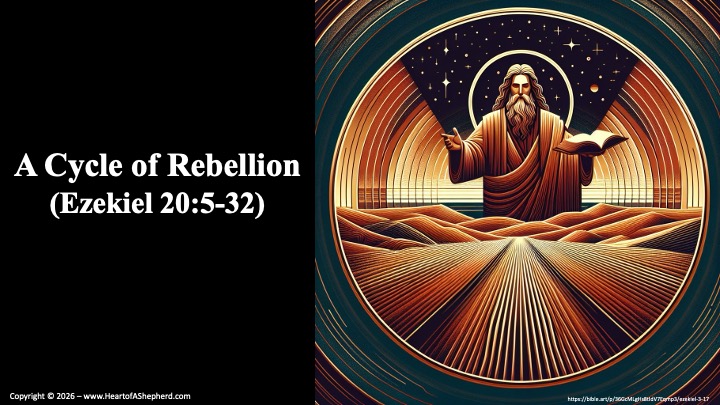
A Cycle of Rebellion (Ezekiel 20:5-32)
The message to Israel’s elders was that the nation had repeatedly rebelled. Instead of delivering a new revelation, the LORD instructed Ezekiel to remind the leaders of how He had dealt with Israel’s past rebellions.

Rebellion in Egypt (Ezekiel 20:5-9)
The first reminder was that the LORD chose “the seed of the house of Jacob” (i.e., Jacob’s twelve sons, the fathers of the Twelve Tribes; Deuteronomy 7:6; Exodus 6:7), brought Israel out of Egypt, and commanded the Jews, saying, “I am the LORD your God” (Ezekiel 20:5).
Reminding them of His covenant with Abraham, Isaac, and Jacob, the LORD promised Israel a land “flowing with milk and honey” and urged them to abandon their idols (Ezekiel 20:6-7). Yet, they rebelled, refusing to worship only the LORD (Ezekiel 20:8). Still, the LORD remembered His promises to Abraham and his seed and decided to bring Israel out of Egypt and into the wilderness (Ezekiel 20:9).
Rebellion in the Wilderness (Ezekiel 20:10-26)
When Israel encamped at Sinai, the LORD gave them His “statutes, and shewed them [His] judgment, which if a man do, he shall even live in them” (Ezekiel 20:11). Yet Israel rebelled and “walked not in [His] statutes, and they despised [His] judgments” (Ezekiel 20:13). Nevertheless, the LORD was merciful and “spared them from destroying them” (Ezekiel 20:17). Though their fathers perished in the wilderness, the LORD spared their children. Yet their children also “rebelled against” the LORD until He “withdrew” His hand from them (the hand that led, protected, and provided for them as a shepherd his sheep, Ezekiel 20:21-22).
Rebellion in Canaan (Ezekiel 20:27-32)
Like their fathers in the wilderness, the people in Canaan cursed the LORD’s name (Ezekiel 20:27), committed spiritual adultery, and offered sacrifices to idols (Ezekiel 20:28). Tragically, like their forefathers, Ezekiel’s generation was guilty of great evils and followed their fathers’ wicked ways. They sacrificed to idols (Ezekiel 20:30) and made their “sons to pass through the fire” (Ezekiel 20:31).
Though the LORD chose Israel to be His people, they rebelled and lived “as the heathen…to serve wood and stone” (i.e., idols, Ezekiel 20:32). For these reasons, the LORD declared to the elders of Israel, “I will not be inquired of by you” (Ezekiel 20:31).

The LORD Promised to Gather Israel from the Nations (Ezekiel 20:33-44)
Despite their wickedness, the LORD promised that He would one day gather His people “out of the countries wherein ye are scattered, with a mighty hand, and with a stretched out arm, and with fury poured out” (Ezekiel 20:34). Jeremiah foretold that the LORD would gather Israel from among “the wilderness of the people” (i.e., nations, Ezekiel 20:35-36). He would continue to discipline them “under the rod” until He brought them back to “the bond of the covenant” (Ezekiel 20:37). He would remove the rebels, who would “not enter the land of Israel,” so that His people would “know” and confess Him as LORD (Ezekiel 20:38).
Closing thought –
Israel forsook the LORD; however, He would not forsake them as His people (Ezekiel 20:45-49). To what end were God’s judgments, and to what purpose were Israel’s sorrows and sufferings? It was that the people would know and confess Him as their LORD (Ezekiel 20:41-42, 44). Indeed, the day would come when “all flesh” would see and know that what was done was the hand of the LORD!
Like Israel, nations that have known the LORD and have been privileged to receive His Word often grow complacent, eventually reject His Word, and invite His judgments. The rise and fall of nations provide ample proof that God is long-suffering; however, He is just, and His judgments are certain (Ezekiel 20:45-47). Indeed, the LORD warns, “all flesh shall see that I the LORD have kindled it: it shall not be quenched” (Ezekiel 20:48).
Copyright © 2026 – Travis D. Smith
* Please subscribe to the Heart of a Shepherd daily devotionals by entering your name and email address at the bottom of today’s devotion.
The Internal Revenue Service recognizes Heart of A Shepherd Inc as a 501c3 public charitable organization. Your donation is welcome and supports the worldwide ministry outreach of www.HeartofAShepherd.com.
Heart of A Shepherd Inc.
7853 Gunn Highway
#131
Tampa, Florida 33626-1611
Heart of a Shepherd
A ministry of Pastor Travis D. Smith
Support Heart of a Shepherd
This ministry is made possible by the generous donations of our readers.
The post The Cyclical Nature of Men’s Sins and God’s Judgments (Ezekiel 20) appeared first on “From The Heart of A Shepherd” by Pastor Travis D. Smith.
“}]]